

West Coast Skip Laurel
Prunus laurocerasus 'West Coast Schipkaensis'View more from Privacy Trees
West Coast Skip Laurel
Prunus laurocerasus 'West Coast Schipkaensis'


this item doesn’t ship to
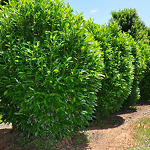
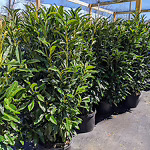
The Skip laurel is a popular screening plant, for good reasons. But it does get large, not just tall, and can soon take up a big part of your garden if you don’t trim it. That’s why we recommend the West Coast Skip Laurel, because it is more upright, with a narrower profile, yet it grows just as tall – well over 10 feet if untrimmed, and is just as tough. Yet it only spreads outwards about 5 feet, so you won’t have to do a lot of trimming -and that’s good news for our busy lifestyles. Growing quickly and adding up to 2 feet a year when established, you will soon have a dense, solid screen for privacy, wind-protection and beauty. The stems grow vertically, not sideways, and the leathery leaves are glossy and deep green. For a dense screen, space plants 4 feet apart in a row that is 3 feet or more out from a fence or property line. You will love how lush it looks, and how tough it is, taking poor soil, drought and deer in its stride. Of course, it doesn’t stop at screening, because this plant is great for filling the corners of your yard, as a single plant or group of three, for framing your front door, for background planting in shrub beds, or for making bold vertical accents almost anywhere.
- Strong vertical growth makes a tall but narrow screen
- Leathery, deep-green leaves look great every day of the year
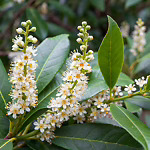
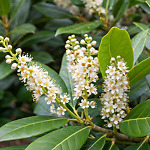
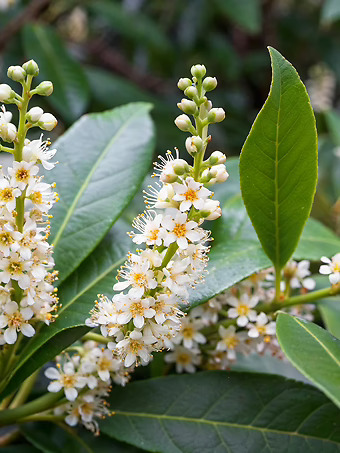
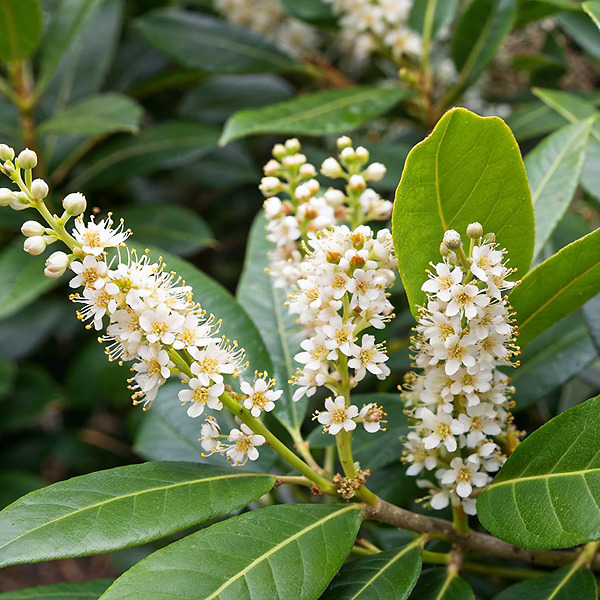
- White flowers in spring, followed by black berries, if grown untrimmed
- Can be trimmed at almost any time, for a super-neat profile
- Tolerates urban conditions, drought, heat and humidity
The West Coast Skip Laurel will grow in full sun in cooler zones, but is best with some afternoon shade in hot ones. It also grows in full shade if it is light, such as the north side of a building, or beneath open deciduous trees. Hardy in zone 6, and in sheltered spots in zone 5, where some winter damage is possible. Plant in any well-drained soil, from clay to sand, but for rapid growth add plenty of compost to the ground when planting, water regularly for the first couple of seasons, and use an evergreen fertilizer in spring. Once well-established it needs nothing at all. It isn’t eaten by deer and almost never has pest or disease problems. Note that the whole plant is poisonous, including the berries. Trimming after flowering, in late spring, is good timing because it removes the berries and leaves time for new growth to appear before winter. Birds will quickly take the berries once they ripen.
Botanical Name:
Prunus laurocerasus 'West Coast Schipkaensis'
Mature Width:
4-6 ft
Mature Height:
10-15 ft
Grows Well In:
Zones 5-9

Sun Needs:
Full Sun, Partial Sun
Water Needs:
Moderate
Growth Rate:
Fast
Flower Color:
White
Flowering Season:
Spring